About the project
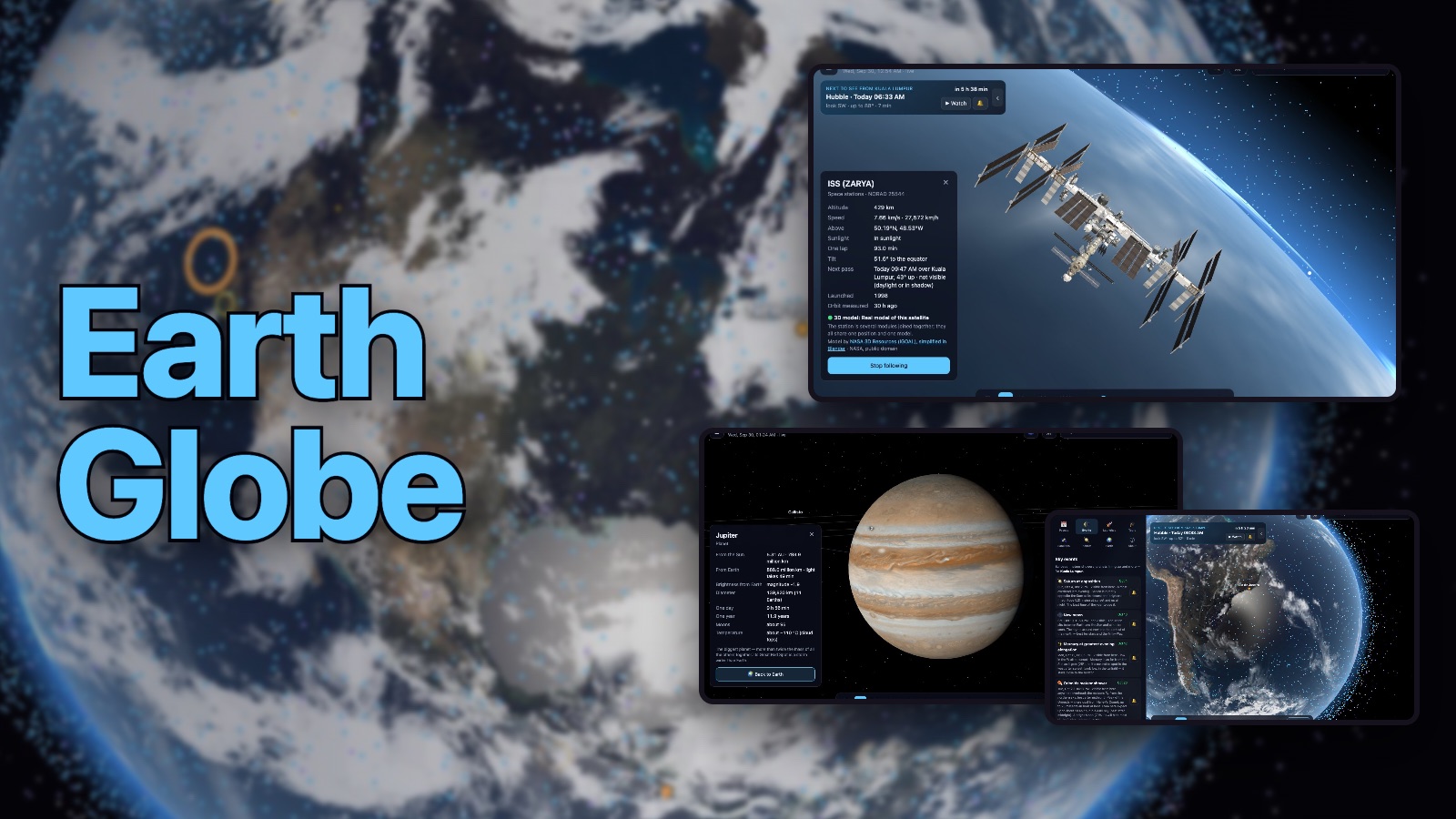
A realistic Earth in the browser — satellite imagery by day, city lights by night, clouds and an atmosphere glow, lit by the real sun — with every tracked satellite in its real position right now: 16,617 working ones, plus the debris clouds. Only orbits are downloaded; a Web Worker runs SGP4 on all of them and the shader slides between snapshots, so they glide instead of jumping. Click one and follow it down to a 3D model at real scale — NASA’s ISS simplified in Blender, a Starlink V2 Mini built by script — with every card saying honestly whether the model is the real satellite, a close relative or a stand-in.
Keep scrolling out and the globe hands over to the whole solar system at real distances: the planets, the Moon and Jupiter’s moons in exact positions, dwarf planets, comets, the 3,000 brightest asteroids and 12 deep-space probes from NASA JPL, Voyager 1 included. A time bar runs the whole thing from 1× to a week per second.
Keep going past the edge of the solar system and it hands over again, to the galaxy: 9,549 real stars at their real distances (HYG catalogue), rings marking 1 to 10,000 light-years, famous places such as the Orion Nebula, the Crab Nebula and the black hole at the centre, and finally the whole Milky Way seen from above — NASA’s illustration, lined up so its Sun sits on ours. Every hand-over keeps the same stars in the same place, so the zoom from a city street to the galaxy has no visible jumps.
It is built to be used outdoors. A banner counts down to the next bright satellite you can see from your location; passes, eclipses, meteor showers and planet meet-ups go into your calendar with a reminder, or arrive as push notifications. The sky view holds 5,044 real stars and all 88 constellations and follows your phone as you point it at the sky. Pass times were checked against Heavens-Above: within about 20 seconds.
Four guided tours explain orbits, the planets, the seasons and eclipses — eclipse shadows are drawn from real geometry — and live layers add earthquakes, the aurora forecast, yesterday’s real clouds and erupting volcanoes. A GitHub Action refreshes every data source every four hours and publishes to Cloudflare Pages.